An immersive in-flight concept designed to keep passengers oriented, engaged and connected to the journey.
UX Designer
Figma · Bezi · Meta Quest 3
Jan 2025 - April 2025
Spatial Design · Immersive Technology
Project Type:
Team Project
My Contribution:
Concept Development, Prototyping and User Evaluation

Overview
Reimagining Time Spent in the Air
SkyView is a VR in-flight entertainment concept designed for long-haul travel. It combines flight information, route awareness, destination discovery, calming environments, entertainment and virtual aircraft views within a seated spatial interface.
The Challenge
Long-haul flights can feel passive, tiring and disconnected from the wider travel experience. Restricted scenery, limited interaction, cabin fatigue and anxiety can make the journey feel like waiting time rather than part of the trip.
Our Approach
We explored several immersive tourism concepts, identified an opportunity within the in-flight experience, translated passenger needs into spatial features and evaluated the prototype with five participants.
The Outcome
A seated VR proof of concept combining journey awareness, destination exploration, relaxation and entertainment within one spatial experience.
Project Starting Point
From a Tourism Brief to an In-Flight Opportunity
Tourism was the assigned project space, but the direction remained open. Rather than considering tourism only as what happens at a destination, we explored the wider journey—from planning and cultural discovery to the hours spent travelling.
This led us to investigate an often-overlooked part of tourism: the time passengers spend between departure and arrival.
Tourism extends beyond the destination
Planning, travelling, arriving and exploring all contribute to the overall tourism experience.
Transit contains unresolved passenger needs
Long-haul passengers may spend several hours feeling bored, restricted, fatigued or disconnected from their surroundings.
Immersion could reshape this time
Instead of adding another destination guide, we explored whether the flight itself could become more connected and engaging.
Before selecting a direction, we explored how immersive technology could support different stages of tourism.
Before Travel
Destination Preview
Allow travellers to explore a location virtually before planning or booking a trip.
During Transit
VR In-Flight Entertainment
Transform time spent travelling into an immersive experience connected to the flight and destination.
At the Destination
Historical Reconstruction
Recreate damaged or ruined historical locations and provide contextual stories about their original form.
Underwater Exploration
Create a virtual diving experience for environments that may be difficult to access physically.
AR Museum Interpretation
Show artefacts in their original state or historical context through augmented reality.
Recognisable passenger problem
Meaningful role for immersion
Multiple connected use cases
Strong interaction-design scope
Selected Direction
VR In-Flight Entertainment
The in-flight concept offered the strongest system-level opportunity. Unlike a single virtual attraction, it could bring together journey awareness, destination discovery, relaxation and entertainment within one connected experience.
Departure
In-Flight
Arrival
Existing in-flight systems provide content, but they do not always address how passengers feel or how connected they are to the journey itself.
Disconnected from the journey
Cloud cover, darkness, seating position and restricted window access can prevent passengers from seeing the world below. Existing entertainment also provides limited connection to the cities and landscapes being crossed.
Mentally and physically tiring
Long flights can involve boredom, poor sleep, anxiety, cabin fatigue and difficulty relaxing in a noisy and confined environment.
Entertainment remains largely passive
Traditional in-flight systems primarily present movies, music and information on fixed screens, offering limited interaction or environmental immersion.
Secondary research was used to understand whether immersive environments could reasonably support relaxation and distraction within confined settings.
Li et al., 2021
Virtual nature may support short-term relaxation
A review of existing research found that exposure to virtual nature may contribute to psychological and physiological relaxation, although the evidence remains developing.
Gafur et al., 2023
Enjoyment may influence acceptance of in-flight VR
Their survey found that perceived enjoyment was an important predictor of attitudes toward in-flight VR among respondents with higher flight anxiety. This supported exploring VR as entertainment.
RESEARCH BOUNDARY
These studies did not establish that SkyView would reduce anxiety or improve wellbeing. They provided a rationale for exploring enjoyment, distraction and calming environments within an in-flight concept.
01
Keep passengers connected
Maintain access to route progress, flight information and cabin notifications throughout the experience.
02
Use VR where presence matters
Prioritise experiences that meaningfully benefit from a surrounding environment rather than copying flat-screen content into a headset.
03
Respect the shared cabin
Design for seated use, limited personal space and minimal physical movement.
Phones, tablets, laptops and seatback displays already support films, games, flight maps and meditation content. VR was therefore not selected simply to reproduce these functions on another device.
Existing screens work well for
Long films and familiar entertainment
Personal productivity
Extended use
Low-cost access
Familiar interactions
VR adds value through
Surrounding 360° destination experiences
Virtual aircraft and pilot perspectives
Calming environments that replace cabin visuals
Spatial organisation of route and flight information
A stronger sense of presence
Possible Service Model
In a more realistic implementation, an airline could provide headsets for selected experiences or premium journeys, reducing the expectation that every passenger would own a compatible device.
Airline-provided headset
Immersive Session
Two scenario-based proto-personas helped translate broad passenger problems into specific moments of use.
Steve
Explore the Journey
Context
A frequent long-haul traveller who wants to make better use of time in the air and discover more about the arrival city.
Needs
Understand the route
Access views unavailable from the seat
Explore landmarks before arrival
Key moment
Steve opens SkyView to view the route, select a destination landmark and enter a 360° city experience.
Emma
Unwind during the flight
Context
A business traveller who feels mentally drained during overnight journeys and prefers simple relaxation experiences.
Needs
Low-effort interaction
Calming visual environments
Guided breathing or meditation
Continued awareness of cabin events
Key moment
Emma selects a calming environment with guided audio while staying aware of important cabin updates.
These proto-personas guided design scenarios and feature prioritisation rather than representing validated market segments.
Features were prioritised according to the passenger need they addressed and whether VR added meaningful value.
Familiar IFE functions were retained where passengers would expect them, while VR-specific features were prioritised where spatial presence created additional value.
Storyboards and low-fidelity sketches were used to explore how journey information, entertainment and immersive content could coexist without overwhelming the passenger.
01
Problem
A single flat menu would underuse the spatial environment and force passengers to repeatedly switch between flight information and selected content.
What was explored
A three-panel layout
Persistent flight information
Central activity content
Supporting route or media panels
Anchored navigation
Design decision
The interface evolved into an anchored spatial workspace: flight information remained visible on the left, the primary activity occupied the central area and contextual media or route content appeared alongside it.


02
Problem
A list of tourist attractions alone would feel disconnected from the passenger's actual route and destination.
What was explored
Interactive map
Landmark cards
Destination information
Curated attractions
Direct access to 360° tours
Design decision
The destination flow combined a live map with a curated landmark list, allowing passengers to understand where a place is located before entering its immersive tour.


03
Problem
Full immersion could cause passengers to miss flight progress, meal service or important cabin announcements.
What was explored
Persistent flight information
Route tracking
Aircraft POV
Cabin notifications
Quick return to the real journey
Design decision
Essential journey information remained persistent, while cabin events were surfaced through clear notifications that did not require passengers to leave the experience completely.


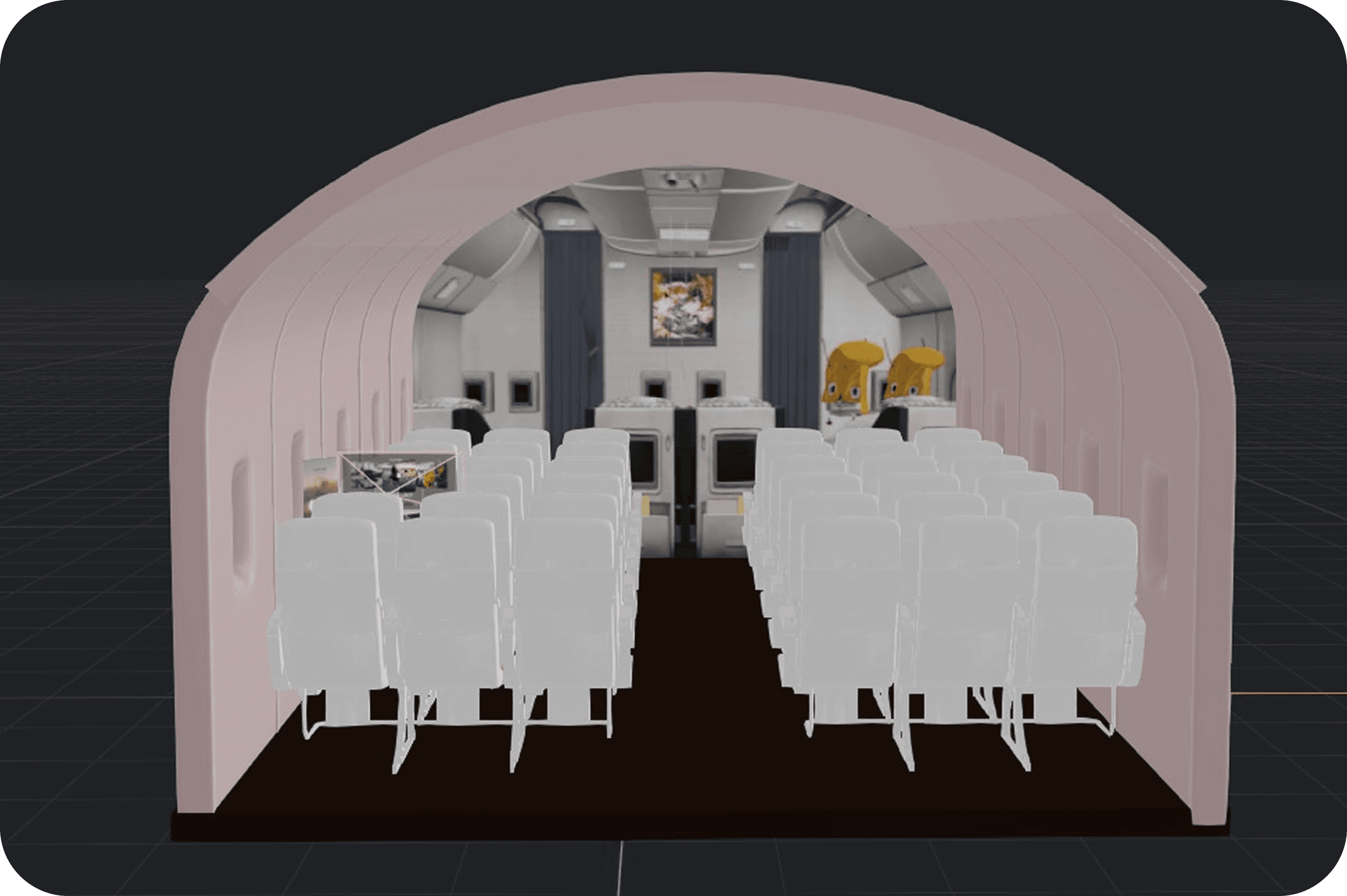

A familiar point of reference
A simplified virtual aircraft interior preserved the context of the real journey and helped passengers understand their position inside the experience.
A seated interface
Panels were arranged around a forward-facing seated position so core functions could be reached without requiring passengers to stand or make large movements.
Connected to the flight
Route information, flight progress, notifications and aircraft views connected the virtual environment to real events occurring during the journey.
The evaluation examined both interface usability and the social experience of wearing and interacting with a VR headset around other people.
5
Participants
Aged 23-27
VR Familiarity
3 participants with previous VR experience · 2 without
Cafe´
Environment
Public setting used to observe social comfort
Bezi
Prototype
Immersive prototype and recorded experience
Methods
Think-aloud feedback
Pre-test questionnaire
Post-test questionnaire
Short interview
Tasks
Explore a virtual tour of the destination
Use a guided meditation experience
View the journey through the aircraft POV
Locate flight information during the experience
01
Virtual views expanded access
Participants valued being able to access the aircraft POV without requiring a window seat.
"I like that I can still see the POV even if I'm not on a window seat."
02
Persistent information maintained orientation
Keeping journey information available throughout the experience helped participants remain connected to the real flight.
"Love that I can keep track of my travel information on all screens."
03
The cabin environment strengthened presence
The aircraft interior helped some participants understand the setting and feel more immersed in the experience.
"It's nice that I can see the interior of an airplane."
04
Social comfort varied between participants
Participants differed in their comfort with wearing a VR headset in a shared cabin, highlighting the need to support both immersive and socially aware experiences.
"I felt really awkward. Like, what if someone was watching me?"
The Prototype concept brought journey information, destination discovery and relaxation into three connected experience groups.
01
Journey information remains available while passengers explore immersive content.

Flight information
Departure, arrival, altitude, speed, weather, seat information and time remaining remain accessible without leaving the current experience.
Route view
A visual overview of the flight path helps passengers understand their location and feel more connected to the journey.
Notifications
In-headset alerts surface meal service and other cabin events without abruptly ending the immersive experience.
Aircraft POV
Passengers can access a virtual aircraft perspective even when they do not have a window seat.
02
Destination content connects the hours spent travelling with the place passengers are travelling towards.

Destination overview
Passengers can browse contextual information about the arrival city and identify landmarks through an interactive map.
Landmark selection
Curated attraction cards support quick discovery without requiring passengers to search through a large catalogue.
360° experience
Selecting a landmark opens a surrounding virtual tour that provides a stronger sense of place than a conventional travel video.
03
Passengers can choose between calming immersive environments and more familiar entertainment.


Meditation Environments
Passengers can enter calming nature-based settings supported by ambient audio, breathing guidance or meditation content.
Entertainment
Familiar movies and media remain available for passengers who prefer conventional content within a larger virtual screen.
Seated games
Interactive experiences are designed around short, low-movement sessions designed for seated, low-movement use
The original prototype was not fully redesigned following usability testing. Instead, the findings informed recommendations for future iterations alongside the project's identified limitations.
Limitations
01
Motion Comfort
Some passengers, particularly first-time VR users, may experience motion discomfort or fatigue.
02
Shared Cabin Environment
Using VR in a public cabin may affect comfort levels for some passengers and requires consideration of nearby travellers.
03
Battery Constraints
Standalone VR headsets may not support continuous use throughout long-haul flights.
Future Opportunities
01
More Context-Aware Interactions
Explore gaze, subtle gestures, and adaptive controls to better suit shared cabin environments.
02
Expanded Short-Session Experiences
Introduce more optional experiences designed around natural breaks during a flight.
03
Faster Cabin Reconnection
Investigate passthrough and quick-exit interactions to help passengers seamlessly return to the cabin environment.
04
Enhanced Onboarding
Develop interactive onboarding that introduces controls, comfort recommendations, and shared-space etiquette.
Reflection
What I learned
SkyView taught me that immersive technology should offer experiences that conventional interfaces cannot. The strongest concepts weren't digital versions of existing in-flight screens, but experiences that leveraged presence—such as virtual aircraft views, destination exploration, and calming environments.
The project also reinforced that designing for VR extends beyond the interface. Social comfort, passenger awareness, physical movement, safety, and session length all shaped the experience just as much as the UI itself.